Showing posts with label BP. Show all posts

Wednesday, November 2, 2011

Senate votes to audit BP claims fund | Pensacola News Journal | pnj.com

Senate votes to audit BP claims fund Pensacola News Journal pnj.com: Senate votes to audit BP claims fund
WASHINGTON — The fund that compensates businesses and people hurt by last year's oil spill in the Gulf of Mexico would be audited under a measure the Senate approved Tuesday.
The proposal, drafted by Republican Sens. Marco Rubio of West Miami and Roger Wicker of Mississippi, passed as an amendment to a package of spending bills. The vote on the package was 69-30.
The amendment would require the Justice Department to find an independent auditor to review the process that the Gulf Coast Claims Facility uses to evaluate and pay out claims of economic damage as a result of the oil spill.
The claims fund was set up last year with $20 billion from BP.
Kenneth Feinberg, administrator of the compensation fund, has said he would welcome an audit and it should be done as soon as possible.
He cautioned that several competing interest groups would want input in the audit process. Groups representing business interests, environmental agendas and low-income Gulf residents already have lobbied claims fund officials.
"You can't win on this independent audit," he told lawmakers last week.
Rubio voted against the overall spending bill Tuesday because he wants to see more cuts to the $182 billion measure that funds agriculture, transportation, housing, law enforcement and NASA programs. But he said he's glad it includes language requiring the audit.
"This amendment brings us one step closer to an audit that will bring greater transparency to the claims process by providing a full review of the Gulf Coast Claims Facility on behalf of those impacted by the 2010 Gulf oil spill," Rubio said in a statement.
Florida Democratic Sen. Bill Nelson, who co-sponsored the audit proposal, voted for the entire spending package.
A similar amendment introduced by Rep. Jo Bonner, R-Ala., was approved by the House Appropriations Committee in July.
Tuesday's vote follows a hearing last week before the House Natural Resources Committee where Gulf Coast lawmakers angrily said the compensation fund has processed claims slowly and inconsistently, and lacks transparency.

Rep. Steve Southerland, R-Panama City, who sits on the Natural Resources panel, last week called the compensation fund process "a flawed payment system that lacks accountability and fails to account for the tremendous economic growth in North and Northwest Florida over the past two years."
U.S. Attorney General Eric Holder visited Orange Beach in Alabama in July to assess damages from the spill and to meet with Bonner. He met later that month with Feinberg, and both agreed to support plans for an independent audit.
"We are pleased that Mr. Feinberg agreed to the department's request that an independent audit be commenced before the end of the year," Wyn Hornbuckle, a spokesman for the Justice Department, said in an email. "We believe the process will benefit from the input we have received from our Gulf partners over the past several weeks, and we remain on schedule and pressing forward."
Gulf Coast lawmakers are irked that it hasn't happened.
News Journal Washington bureau reporter Ledyard King contributed to this story.

Wednesday, September 28, 2011

Updated: Feds order Transocean to investigate oil floating above well responsible for Deepwater Horizon spill | al.com#incart_hbx#incart_hbx#incart_hbx#incart_hbx

Updated: Feds order Transocean to investigate oil floating above well responsible for Deepwater Horizon spill al.com#incart_hbx#incart_hbx#incart_hbx#incart_hbx: Updated: Feds order Transocean to investigate oil floating above well responsible for Deepwater Horizon spill

Updated at 6:59 p.m. to reflect BP comment at close of story.
MOBILE, Alabama — The U.S. Coast Guard announced Tuesday that it would require Transocean, owner of the drilling rig that exploded and unleashed the Gulf spill, to determine the source of the BP oil found floating above the wellhead.
The announcement came one month after the Press-Register collected samples of oil bubbling up on the surface of the Gulf of Mexico and sent them to Louisiana State University for scientific analysis.
The newspaper visited the well site 4 days after Bonny Schumaker with On Wings of Care and the Gulf Restoration Network first observed oil on the surface during an Aug. 19 overflight.
Coast Guard Capt. John Burton, commanding officer of the Morgan City Marine Safety Unit, said the agency routinely issues Notices of Federal Interest to companies believed to be responsible for sheens found floating on the Gulf’s surface. He said federal officials do not believe the well is leaking.
Burton said the Press-Register samples, coupled with repeated sightings of sheens in the area by Schumaker and interviews with LSU chemist Ed Overton, suggested that oil originating from BP’s well was making its way to the surface.
The notice stated that the oil on the surface suggests “the possibility of a release from the riser pipe or other debris on the ocean floor from the April 20, 2010, Deepwater Horizon incident.”
“They did the survey of the well, and it doesn’t seem to be coming from there, so we’re looking at other sources. One of the possible sources is the wreckage of the Transocean rig,” Burton said. “One option is to send down a remote vehicle. Certainly a survey of the wreckage, a survey of the riser pipe is appropriate.”
The notice also says that Transocean may be responsible for debris removal costs.
"If a volume of oil has remained in the riser, there is no question that it is oil from BP’s Macondo well," Transocean PR spokesperson Lou Colasuonno said in an email.
"As owner and operator, BP is the responsible party for all fluids that emanated from the Macondo well head, and BP has repeatedly acknowledged that responsibility. Transocean has accepted responsible party status for rig fluids, such as diesel fuel, consistent with the law. We take this very seriously, and we are committed to working with BP, the Coast Guard, and other parties to investigate these reports."
In the weeks after LSU’s Ed Overton described the Press-Register’s oil samples as a “dead ringer match” for oil from BP’s well, federal officials suggested the oil might have come from another source, such as a natural seep.
Overton, who did much of the government’s oil sampling work during the BP spill, conducted additional analyses suggested by BP and federal scientists and ruled out natural seeps and nearby production wells.
He urged officials to conduct a thorough survey of the wreckage of the Deepwater Horizon using machines designed to sniff for oil underwater to determine the source of the oil on the surface.
Petroleum engineers have said it was important to rule out other, more remote possibilities, such as oil bubbling up around the outside of the sealed well.
“Transocean will come up with the best way to determine if they are the responsible source,” Burton said.
A BP spokesman said the company would work with the Coast Guard to identify the source of the oil at the site.
"As we have said and the U. S. Coast Guard now confirms, the Macondo well is not leaking oil and is not the source of the sheens," said spokesman Ray Melick. "We will continue to cooperate with the Coast Guard to investigate other possible sources, including Transocean's riser

Wednesday, May 11, 2011

BP working to remove tar mats on Perdido Key | Pensacola News Journal | pnj.com

Originally Published by the Pensacola News Journal

BP working to remove tar mats on Perdido Key | Pensacola News Journal | pnj.com: "BP working to remove tar mats on Perdido Key"

BP contractors have begun work today to remove two more submerged oil mats just off the beach near Eden Condominium on Perdido Key.


The process is expected to take four days for each tar mat, weather permitting, said Floyd Sanders, section planning chief for BP’s Florida restoration organization.


These oil mats were discovered in late April by a shoreline assessment team of representatives from BP, Florida Department of Environmental Protection and the Coast Guard. One mat is just east and the other just west of the oil mat that was removed in March. Sanders said.


The mats are in about 3 feet of water and are being removed by an excavator sitting on the beach. The excavator is able to dig up the underwater mats that are buried in the sand on the Gulf floor. The excavator’s arm can reach up to 45 feet offshore.


Once the job is completed, the areas will be reassessed to make sure all of the mats were removed, Sanders said.


The operations are independent of, but coincide with, a plan BP is about to launch to test a number of sonar methods to search for suspected tar mats farther offshore – between water that is four feet deep out to the edge of the second sand bar -- along Pensacola and Perdido key beaches. That operation is expected to take more than two months.

Editorial: Gulf research is critical

Editorial: Gulf research is critical

Originally Published by Pensacola News Journal

Link: http://www.pnj.com/article/20110511/OPINION/105110309/Editorial-Gulf-research-critical?odyssey=mod|newswell|text|FRONTPAGE|p

Concerns about sick red snapper and other fish in the Gulf of Mexico make clear the importance of continued, long-range research into the environmental impact of the BP oil spill.

The layman's logical step is to conclude that the problems in the fish — including skin lesions, spots, liver blood clots and fin rot — are connected to the oil spill. But scientists admit they don't yet know the cause, and that it could be something else.
Maybe it's a natural condition that has been exacerbated by the stress the spill induced in fish.
A roster of state and federal agencies testing seafood assure us that it is safe. They report no traces of oil-related chemicals being found in commercially available seafood. But perhaps their testing method — obtaining fish from local seafood markets across the Gulf Coast — selects out the sick fish because fishermen don't try to sell them to the markets, or else the markets won't buy them.
That could simultaneously mean that seafood available for sale is indeed safe, but that there are also sick fish out there.
It could also raise concerns about how long the fish are sick before these problems manifest themselves. Could the sickness in the fish make them unhealthy for human consumption even though they don't show any signs of oil contamination at that point?
It shows the complexity involved in trying to identify environmental problems.
Dick Snyder, director of the University of West Florida's Center for Environmental Diagnostics and Bioremediation, made the point well: "Cause and effect is a huge problem for environmental work. You see anomalies in fish. Is it oil related? How do we prove it? We can make the connection with economic stuff. But after the oil is gone, how do you definitely say the fish are sick because of the oil spill?"
Snyder said that we might never know the full impact. But the only real chance we have is to continue the research, and to increase the focus anytime a specific problem surfaces.
Certainly, this problem is one that bears more intense scrutiny

Tuesday, April 19, 2011

FT.com / Companies / Oil & Gas - Exxon chief says BP lost time

FT.com / Companies / Oil & Gas - Exxon chief says BP lost time: "Exxon chief says BP lost time"

GO to the LINK to View the Video!
http://video.ft.com/v/910041966001/BP-one-year-on


Exxon chief says BP lost time
By FT reporters

Published: April 19 2011 21:10 | Last updated: April 19 2011 21:10

BP lost valuable time at the height of its devastating accident in the Gulf of Mexico last year pursuing solutions to contain the oil spill that were never going to succeed, the chief executive of ExxonMobil has claimed.

In a sharp criticism of the handling of the disaster, Rex Tillerson said Exxon’s engineers knew that one of BP’s initial efforts to stem the oil flowing from the ruptured Macondo well – by building a containment dome – “wasn’t going to work”.


More FT videoEDITOR’S CHOICE
Silent minute to mark year of change at BP - Apr-19.BP clean-up costs to soar, say experts - Apr-19.Graphic: how the BP spill happened - Apr-19.Video: BP one year on - Apr-19.California steps out on bold green venture - Apr-18.Testing times await disaster response units - Apr-17..“We knew they were going to form hydrates [a type of ice], which they did,” he told the Financial Times on the eve of the first anniversary of the accident which killed 11 workers and led to the worst offshore oil spill in US waters. There was, he added, “a significant loss of time while they pursued that option and while that was going on, the integrity of the well itself was deteriorating daily”.

He said: “So I think there was some time lost pursuing some alternatives that most of us felt that in the end were not going to be successful – and with the loss of time the challenges just got greater.”

Exxon, he said, had learnt over the years that in crisis situations like the Gulf accident, companies needed to act quickly and aggressively “because these situations only get worse with time”.

Mr Tillerson has formerly criticised BP about its assessment that there are industry-wide lessons to be drawn from the Deepwater Horizon accident – but his remarks about the handling of the crisis are the most specific to date.

BP responded: “We made all efforts to contain the well and worked closely with industry, US federal agencies and regulators on proposals to respond to the incident at the time. Our response drew on all of those.”

Mr Tillerson said he would be concerned if the public or regulators were to be told that “this industry was operating on the edge of its capabilities as we moved into ever-deeper water”. He added: “[That] flies in the face of 14,000 wells that were drilled without this happening.”

A year after the accident, only 10 fresh drilling permits have been issued in the gulf. “We are not back to business as usual. I can’t really see the end,” Mr Tillerson said.
.

Wednesday, April 6, 2011

Surfrider Foungation is sponsoring Beach Oil Testing this weekend - Baldwin County NOW - A Gulf Coast Information Source for South Alabama

Surfrider Foundation is sponsoring Volunteer oil testing on Florida beaches this weekend. The Testing is to take place in South Walton County and Pensacola Beach.

Surfrider Foundation would like to invite any and all volunteers from the surrounding area's to assist in this second phase of testing our area Water and Beaches for oil along Gulf since last year’s oil spill.

The second phase consists of digging three trenches along beaches on April 10 in Pensacola and South Walton County and taking core samples of the sand to submit for results, according to the nonprofit group’s news release.

“Based on our initial results we are seeing heavy settling of oil in our beaches that are not being cleaned up but rather just grinded into place,” the news release stated.

The Surfrider Foundation is a nonprofit environmental group dedicated to protection of the world’s oceans, waves and beaches, according to the release.

For more information, visit the group’s website at http://www.surfrideremeraldcoast.org/ or contact Mike Sturdivant at 850-225-1747 or emeraldcoast@surfrider.org.

Wednesday, March 23, 2011

Fort McRee Recon for Tarmats 3-22-11

3-22-11 Fort McRee Recon for Tarmats

The following are pictures from our trip to Fort McRee on the very east end of Perdido Key. We had some friends in from Germany who are doing a "One Year Later"  project on the Oild Spill and we wanted to show them some Tarmats that BP seems to continue to "overlook".


The Gulf Islands Nat Seashore sign at Fort McRee.

Our Track


Melting tarmats

 The Big Nasty
Older Oiled Jetty Foundation that is starting to melt and run down the rock!


We have some extremely knowledgable folks who are helping us with locations...


Runny Oil on our beaches ... just what I was hoping for a year later!


If you can look closely in this photo...it's tarmats and tarballs are everywhere.  Email me and I will send you the original photo.  chuckb61at gmaildotcom.


When I look at this Photo I keep getting the Gilligans Island Theme Song running through my head...... three hour tour...

Tuesday, March 1, 2011

Particularly Deadly Night on Perdido Key, FL

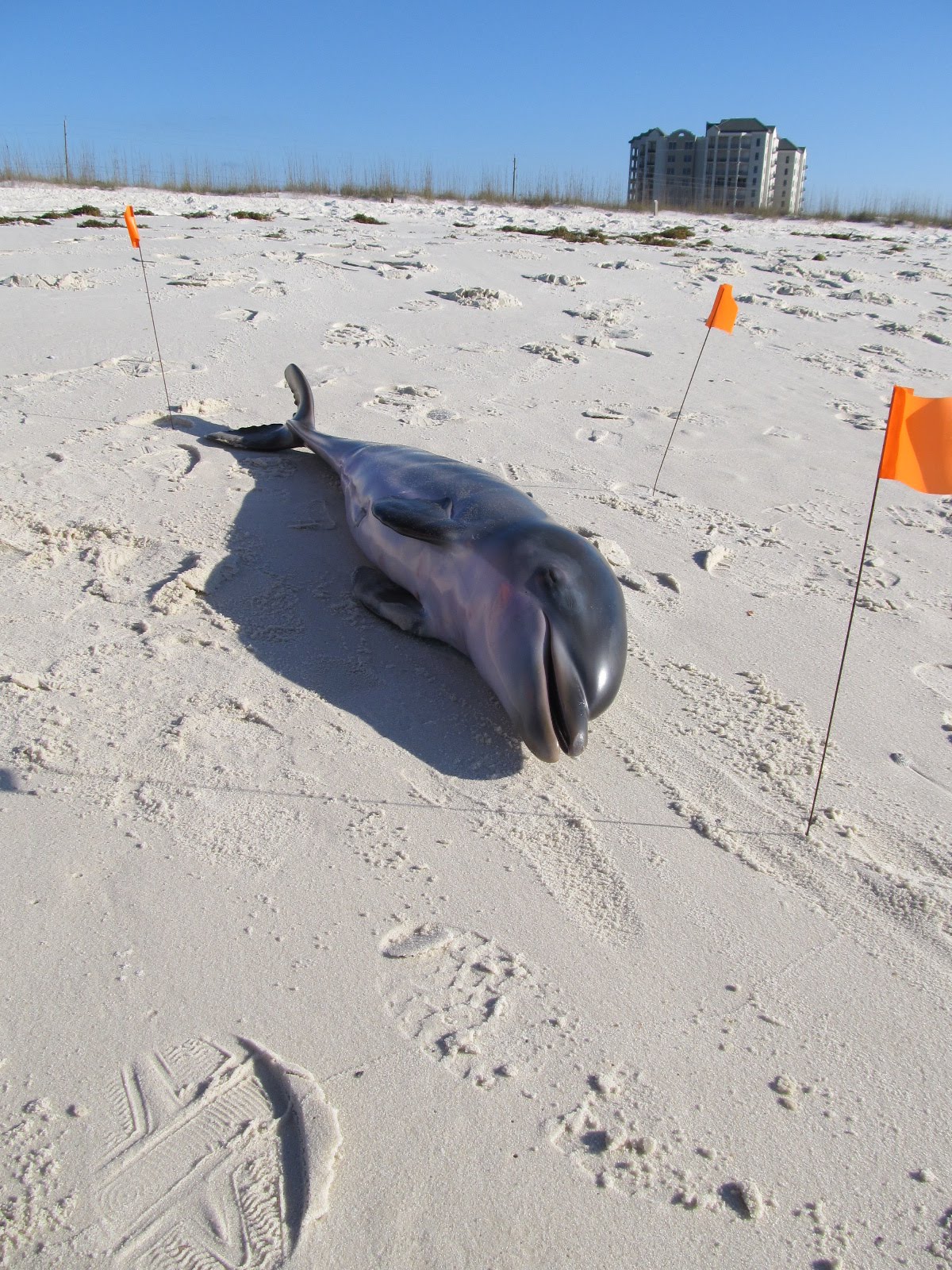
One more Juvenile Porpoise and Turtle found this morning on Perdido Key.


I figured my foot would give you some scale.

From Cleanup to Recovery

From Cleanup to Recovery: "From Cleanup to Recovery"

From Cleanup to Recovery
sr110113a
The relatively few, isolated incidents of oil coming ashore were dealt with quickly and efficiently, say economic developers along the Gulf Coast, but the national press never bothered to report the full story on the cleanup.
Source: Gulf Shores (Ala.) Convention and Visitors Bureau.
In the aftermath of the BP oil spill in the Gulf, what's needed is a massive and expeditious response.
N
ine months after the Deepwater Horizon oil rig explosion and ensuing spill in the Gulf of Mexico, the people and communities of the Gulf Coast region are still awaiting the massive relief effort that has never materialized.
Yes, the oil has largely been cleaned up and removed from the Gulf's waters, estuaries and bays, and the Gulf Coast Claims Facility has paid out billions in BP funds to victims of the disaster.
But the real help that is desperately needed, from Florida to Texas, has yet to arrive.
Companies are closing. People are losing their jobs. Whole industries are being shut down. Communities are cutting back services and laying off workers. And the voices of civic leaders are crying out for help.
So far, that aid has been slow in coming, if it has come at all.
"BP's first words to us after the spill were, 'We will make you whole,' " says Bob Higgins, vice president of the Baldwin County Economic Development Alliance in coastal Alabama. "It turned out that this was an overstatement."
Inefficiencies, bureaucratic delays and downright incompetence are all hindering the claims process that was designed to pay restitution to the victims of the spill's economic impact and help beleaguered communities recover.
"More stress has been caused by the broken claims process than was caused by the disaster in the first place," Higgins says. "Without that process being fixed, affected businesses in our region will face a hard road to recovery."
Throughout the five-state region of the Gulf Coast, a clearer picture of the oil spill's devastating effect is starting to emerge.
"The oil spill's effects are expected to last a number of years," according to Samuel Addy and Ahmad Ijaz of the Center for Business and Economic Research at the University of Alabama. "In the worst case, the oil spill results in losses of $3.3 billion in Alabama economic output, $971 million in earnings, and nearly 49,000 jobs for 2010."
The best case results in losses of about $1 billion in economic impact and the loss of 13,600 jobs in Alabama, the researchers conclude in their comprehensive report on the economic impact of the BP oil spill.
Whichever estimate is closer to reality, the bottom line is this: Alabama has been severely damaged by the spill and various public policy decisions and media-generated public opinion in the wake of the disaster.
'We Still Face the Perception Problem'
According to Herb Malone Jr., president and CEO of the Gulf Shores & Orange Beach Tourism agency in coastal Alabama, lodging revenue was down 41.5 percent and retail sales were down 22.9 percent in the summer of 2010 versus 2009 along the state's coast.
Adam Sacks, managing director of tourism economics for Oxford Economics in Philadelphia, extensively studied the oil spill's effect on Gulf Coast tourism in 2010 and concluded that "the interest in beach area vacations along the Gulf Coast plummeted for key destinations."
Among the hardest hit areas, he said, were Gulf Shores, Ala.; Pensacola, Fla.; and Fort Myers, Fla. Hotel bed tax collections were down sharply in Bay, Broward, Escambia, Citrus and Gulf counties in Florida, and recreational sales taxes were down by 50 percent in Franklin County, Fla.
The problem, according to economic development officials along the Gulf Coast, was the media-generated perception that tar balls were washing ashore from Texas to Florida all summer. But that was simply not the case. The relatively few, isolated incidents of oil coming ashore were dealt with quickly and efficiently, they say, but the national press never bothered to report the full story on the cleanup.
"We still face the perception problem," says Chris Laborde, an official with the New Orleans Regional Transportation Management Center and a leader of the multi-state Gulf Coast Alliance. "The perception is that we have oil-tainted beaches and seafood, and that is blatantly not true. And the drilling moratorium by the federal government is a real killer for small businesses, especially for those who sell products and services to the offshore oil and gas drilling, even for shallow draft drilling."
Jeff Helms, vice president of PBS&J in Pensacola and volunteer chairman for Florida's Great Northwest, tells Site Selection that "tourism was hit pretty hard this past summer. Our secondary industries of food and lodging were hit hard in Gulf, Escambia, Franklin, Santa Rosa and Washington counties. Gas stations and fast-food restaurants were hit too. Whenever the beaches suffer, they suffer."
The result was a lost year for tourism and economic development in Northwest Florida, he said. "The perception created by the media hit us badly. It hit our economic development pretty hard," he notes. "We basically skipped a year."
Help that was promised, in the form of relief payments from the $20-billion fund set up by BP, has not come fast enough for the businesses and communities that need it most.
The administration of President Obama took over the relief payment process last summer and assigned that task to new claims czar Ken Feinberg, the official who had earlier presided over the much-criticized relief fund for 9/11 victims.
His track record for helping the victims of the BP oil spill has been even worse, say dozens of business and community leaders interviewed by Site Selection for this article. Queries to the office of Feinberg by phone and e-mail were not returned.
"The bottom line on the claims process is that Mr. Feinberg over-promised and under-delivered," says Helms. "He did make some adjustments, after we complained, and the money started flowing a lot quicker. The problem is that these businesses along the coast were hit, and they have to make 80 percent of their annual revenue in the summer. When it takes such a long time to get your check cut, it is very difficult to pay your workers."
Lack of Accountability Frustrates Local Officials
Help is needed now so that companies can keep their workers employed and so that communities can do remedial marketing.
"If the oil spill fine money is reallocated to the coast, we will be fine," says Helms. "The problem is that we do not want to lose another year. We need some revenue to help the economic development folks reach out and let everyone know we are okay. We need the money to do marketing now, not later."
Higgins adds that the longer Feinberg waits to pay claims, the worse the situation is going to get on the ground. "It is very bad right now. We have 20 mental health people on the ground right here in Baldwin County," he says. "How do we get our arms around this, especially if we don't have the money we need to help these people recover?"
Higgins says that nothing less than a full-scale relief program from Washington is needed to help the region rebuild its economy. "We would like to see programs out of Washington that encourage investment to happen here, similar to the Gulf Opportunity Zone program after Hurricane Katrina and Hurricane Rita in 2005," he says. "We need to incentivize buyers to invest in the entire five-state region."
Donna Watts, CEO of the South Baldwin Chamber, says the sooner that relief arrives, the better. "The impact to our businesses has been dramatic," she says, while fighting back tears borne of anger, frustration and a sense of loss. "The Gulf Coast Claims Facility has been worse than anything I have ever dealt with in my entire life. Our businesses are failing and closing. We are struggling every day, trying to help as much as we possibly can. The money is still not coming to Alabama. We are far, far, far from being made whole."
Appeals for help from Feinberg's office have fallen on deaf ears, says Watts. "The only person I know of who can make a difference in this small area of South Alabama is President Obama, and to get his attention right now is a difficult thing to do," she says. "We have people going out of business who have run their family business for decades. We are seeing our free and reduced-price lunch rolls go up in our schools. Our children who are classified as homeless are increasing. That speaks volumes of our economic crisis here. People are not dying from starvation, but there is human suffering going on here."
Watts wants to make it clear that the proud people of South Alabama do not want charity. "We have said all along that we do not want a handout," she notes. "We don't want to just get a check. We want to help BP save us, and we know how to do that better than anyone else. We know how to recover. Living on the coast, you learn how to do that, but we need a shot at recovery. If you give us a shot at recovery, we will make it work."
Tourism-dependent communities are not the only ones looking to Washington for relief. The hard-hit oil and gas exploration industry is desperate for help as well.
"The moratorium on new oil drilling in the Gulf of Mexico is and was unnecessary from the outset, and the delay of future drilling only adds to the cost burden that American consumers will experience in gasoline and diesel prices," says John Hofmeister, former president of Shell Oil Company and the founder and CEO of Citizens for Affordable Energy.
"The federal government is in shutdown mode," he says. "In six months, the shallow water of the Gulf has received the equivalent number of permits that it used to receive monthly, and there are zero new permits for deepwater — therefore, no new drilling since the May 25 shutdown of the industry. Meanwhile, the rest of the world keeps drilling for oil offshore in deepwater."
A Proposed Four-Step Action Plan
The Houston-based Hofmeister says that while large companies can absorb the impact caused by the moratorium, small businesses cannot. "For the small companies directly dependent on the Gulf of Mexico for most if not all of their livelihood, they are either shut down or operating on longstanding maintenance projects," he says. "The head of the Gulf of Mexico for a major services firm told me in September that they had effectively shut down payments to about 2,000 companies for Gulf of Mexico work."
When asked what was needed to prompt change in Washington, Hofmeister said, "It will take more than industry pressure to move the administration to a different permitting environment. Until American consumers pay an exceedingly high price for gas at the pump, there will be no change in policy."
What's needed to help the devastated economy of the Gulf Coast region is swift and remedial action. A broad-based aid plan should include the following:
  • Expedited Gulf Coast Claims Facility payments, whereby damaged companies and individuals are recompensed appropriately and quickly. A deadline for paying out the $20 billion in damages should be set and the payment process fixed to match it.
  • A new GO Zone program, created to specifically jumpstart investment in the hardest hit communities along the Gulf Coast, should be fully funded and ramped up to incentivize new investment into coastal economic development as soon as possible.
  • The U.S. Department of Interior should scrap its ill-fated, de facto drilling moratorium in the Gulf in exchange for a common-sense policy compiled by a coalition of private industry engineers and government scientists.
  • An influx of marketing dollars targeting beleaguered industries to help them recover. This should include fishing, tourism, restaurants, recreation, lodging and other industries in Florida, Alabama, Mississippi, Louisiana and Texas.
If Washington would devote the same attention to helping Gulf Coast communities recover from the BP oil spill as it did to helping the victims of Katrina and Rita, then places like Foley and Gulf Shores in South Alabama would recover sooner rather than later.
These communities have already lost one year to the economic fallout of the spill. If they lose another, it will be only because decision-makers in Washington lacked the political will to act.

Saturday, February 12, 2011

Alabama tourism dollars drop $100M after oil spill | pnj.com | Pensacola News Journal

Alabama tourism dollars drop $100M after oil spill pnj.com Pensacola News Journal: "Alabama tourism dollars drop $100M after oil spill
Associated Press • February 12, 2011"

Alabama tourism dollars drop $100M after oil spill


Associated Press • February 12, 2011

GULF SHORES, Ala. — Tourists spent almost $100 million less visiting Alabama's main tourist beaches last year than the year before the Gulf oil spill, a tourism official said Friday.


The vice president for the Gulf Shores-Orange Beach tourism agency, Mike Foster, said Friday that $144 million was spent in the Baldwin County beach communities of Orange Beach, Gulf Shores and Fort Morgan in 2010. That compares with $241 million in 2009, the year before the spill. The spending figures include money spent at hotels, restaurants and beach-related businesses, such as souvenir shops and beach chair rental stands.
"That is very significant," Foster said.

Associated Press

He said the decrease showed people, concerned by images of oil- and tar-coated sands, stayed away from the beaches. Tourism plummeted across the coast after BP PLC's well in the Gulf of Mexico blew out in April, spewing millions of gallons of crude into the sea. Crews spent weeks clearing oil and tar balls from the beaches.
Foster said the number doesn't include revenues from people who stayed in motels or hotels in nearby communities like Foley or Mobile, or those who made a one-day trip to the shore. He said it also doesn't include revenue lost from tourists who would have stayed in motels or visited restaurants across Alabama on their way to the Gulf Coast.
The loss is probably worse than the numbers show because many merchants, hotels and motels offered large discounts to spur business, Foster said.
The Alabama Attorney General's Office has filed a lawsuit seeking to recover revenue lost by the spill. A spokeswoman for Attorney General Luther Strange, Jessica Garrison, said the tourism figures would be an important part of the overall assessment of damages to the state caused by the oil spill. She said Strange is working with Gov. Robert Bentley to determine Alabama's total economic loss as a result of the oil spill.
State tourism officials said 1 million fewer people visited Alabama's beaches in 2010 than in 2009. That figure was part of an annual report on the state's top tourist attractions.
The report said 3.6 million people visited Alabama beaches in 2010 compared with 4.6 million 2009. While the number of visitors to attractions on the Gulf was down, other attractions across the state showed an increase in visitors in 2010.
Gulf State Park alone recorded 300,000 fewer visitors in 2010 than the previous year.
Advance bookings suggest more people will visit the coast this year, but the numbers aren't likely to hit 2009 levels, Foster said.
"I hope that people who come for spring break take the message home that everything is fine," Foster said.
AP-WF-02-11-11 2331GMT

Tuesday, February 8, 2011

Keep an eye out to help national bird count | pnj.com | Pensacola News Journal

Keep an eye out to help national bird count pnj.com Pensacola News Journal: "Keep an eye out to help national bird count"

Keep an eye out to help national bird count


Travis Griggs • tgriggs@pnj.com • February 7, 2011

Bird-watchers across the country will get to use their skills for science this month during the Great Backyard Bird Count.

The event, a joint project of the National Audubon Society and the Cornell Lab of Ornithology, pools the efforts of thousands of amateur bird watchers to count birds near their homes and report their findings to a website.
Audubon and Cornell researchers use the data to learn more about how environmental changes affect birds and how to protect them.
"It gives a picture, a quick snapshot, of where the birds are and how they're doing," said Peggy Baker, a president's council member at the Francis M. Weston Audubon Society.
The count this year is Feb. 18-21. Anyone can participate, from novices to expert bird-watchers. Organizers ask that participants count birds for a minimum of 15 minutes on one day of the event.
Last year, participants submitted more than 97,200 bird checklists, a 4 percent increase over the previous year.
Baker said the event can be an eye-opening experience for local residents.
More information is available at http://www.birdsource.org/, including checklists, guides and other tools to help participants identify and report birds likely to inhabit their area.

Thursday, November 4, 2010

Todays Water Testing

11-4-10 Testing Sites

I was able to test four sites today. Mike Sturdivant suggested I try to work alot of the most heavily impacted areas from the June and July blackouts.

The four sites we settled on are as follows:

Fort Morgan, AL (Bon Secour Wildlife Refuge Beach Access Site)


View Unnamed Rd in a larger map


Gulf Shores, AL (Gulf Shores Public Beach East Access)

View 30.246908, -87.687979 in a larger map">

Orange Beach, AL (Cotton Bayou State Park Beach Access)

View 30.269094, -87.581871 Cotton Bayou State Park Beach Access in a larger map

Perdido Key, FL (River Rd Public Beach Access Site)

View 30.293109, -87.45136 Perdido Key, FL River Rd. Public Beach Access in a larger map

Friday, October 29, 2010

First Surfrider Water Testing Starting 10-28-2010

The Emerald Coast Chapter of the Surfirder Foundation has agreed to fund a Water testing program in our area. Mike Sturdivant is the President of the Chapter and will be my contact to operate the testing progam.

We have had several incidents of "surfer sickness" during some of our swells since BP capped the well in early August. I believe we all need to have some idea as to what is going on in terms of the environment we recreate in. Unfortunately right now we just don't have any local, state of federal testing data to look at in the areas we frequent.

Today we tested two sites, Terry's Cove aka Cotton Bayou State Park and the Jetty @ Alabama Point. These are certainly our two most surfed areas so I felt like we should get some test run here immediately. Test results take 2-3 weeks to get back from the lab. I will post results and blast everyone via email.

Maps of the two sites tested

Cotton Bayou State Park aka Terry's Cove

View 30.269094, -87.581871 in a larger map">

Alabama Point

View Larger Map">

I will be looking for volunteers to help with the process in the coming weeks so hit me up on gmail chuckb74atgmaildotcom.

I have some photo's I'll be posting. Thanks