4 dead dolphins wash up on Gulf Coast beaches in 5 days; deaths part of 'unusual mortality event' al.com: 4 dead dolphins wash up on Gulf Coast beaches in 5 days; deaths part of 'unusual mortality event'
Courtesy of blog of al dot com
4 dead dolphins wash up on Gulf Coast beaches in 5 days; deaths part of 'unusual mortality event'
Published: Wednesday, October 12, 2011, 6:29 AM Updated: Wednesday, October 12, 2011, 6:53 AM
By Ben Raines, Press-Register Press-Register
Follow 5
Share close Google Buzz Digg Stumble Upon Fark Reddit
Share
Email
Print DAUPHIN ISLAND, Alabama -- A dolphin carcass, bloated and violet in the morning sun, was found on Fort Morgan early Saturday, bringing the number lost since the BP oil spill to more than 400.
Three other dolphins have washed up in Alabama in the past week, including a pregnant female on Dauphin Island and a mother and calf pair on Hollingers Island in Mobile Bay.
Courtesy of John C.S. PierceThis dolphin was found on the Mobile Bay side of the Fort Morgan peninsula Saturday morning, one of four found since Friday. The death brings the total number of dead dolphins found since the BP oil spill to more than 400. Federal officials say an "Unusual Mortality Event" has been declared for the Gulf's dolphin population, which have been dying at a rate 5 to 10 times higher than average.
"We should be seeing one (death) a month at this time of year," said Ruth Carmichael, a Dauphin Island Sea Lab scientist tasked with responding to reports of dead dolphins. "We’re getting one or more a week. It’s just never slowed down."
An examination of the Gulfwide death toll, broken down by month, reveals that dolphins continue to die at rates four to 10 times higher than normal. For instance, 23 dolphins were found dead in August, compared to a monthly average of less than 3 each August between 2002 and 2009.
Federal scientists acknowledge they are no closer to solving the mystery behind the "Unusual Mortality Event" that has been sweeping through the Gulf’s dolphin population since March of 2010, one month before BP’s well was unleashed.
But progress has been made, federal officials said, noting that tissue samples are now being sent to various laboratories for analysis. No results have been released.
"We have samples out now, and they’ve been going out for a while," said Jenny Litz, a research biologist with the National Oceanic and Atmospheric Administration. "We still have animals stranding. I would say the event is still unfolding."
Blair Mase, NOAA’s point person for all dolphin strandings in the Gulf, said that reports of dead dolphins have remained stubbornly high, meaning a final report is a long way off. She said that most of the casualties now are adults.
Stillborn or juvenile dolphins made up nearly half of the casualties in February and March this year, but 90 percent of the deaths since then have been adults. Scientists said part of the explanation is simply timing. Dolphins typically calve in the spring, meaning pregnant females and newborns are at their most vulnerable between February and May.
Though many believe a link between the BP oil spill and the elevated death rate seems obvious, dolphins actually began dying a month before the spill.
'Unusual mortality event' for dolphins not unheard of
To report dead dolphins
To report dolphin and other marine mammal strandings, call: 1-877-942-5343 (1-877-Whale-help).
In March of 2010, 56 dolphins washed ashore in the Gulf, compared to the seven-year average of 16 for the month.
Mass die-offs of dolphins are not unheard of. Fifty-three dolphins washed up on South Carolina beaches this year, and three or four such events typically occur each year around the country.
The majority of the time, the official cause of death is listed as "undetermined," according to federal records.
What’s unusual about what is happening in the Gulf is the duration of the die-off, now well into its second year. It’s possible, scientists said, that whatever killed dolphins in March of 2010 — be it a cold winter, scarce food supplies, or a virus — meant the population was already in a weakened position when the Gulf spill began.
"Clearly, something is going on. My prediction is that it is not going to stop in the near time, if it is what we’re afraid it might be," said Graham Worthy, a University of Central Florida researcher specializing in examining the blubber layer of dolphins and seals to glean information about their health.
"Earlier this year, with the major die-off of the neonates, one of the ideas scientists were throwing around was the disruption of the food chain. Many folks had speculated that was one possible outcome of the spill."
Worthy said such a disruption could weaken the health of the dolphin population on a broad scale, though he cautioned that he has not received any samples from federal officials for analysis.
"I haven’t seen any of these dolphins and don’t know their physical condition. Without tissue samples, all we can do is speculate," Worthy said. "But there have been some interesting stories lately, about abnormalities in developing fish in Louisiana, and reports of the shrimp catch being way, way down this year. Something similar happened after Exxon Valdez, where they had record catches the year after the spill, then a number of species crashed and have never recovered."
Carmichael said the scientific community could do little more than guess about the causes of the deaths until the carcasses have been analyzed.
"We don’t know about lesions on the animals, or about the blubber content. Those are the kinds of analyses we are waiting on," Carmichael said. "When they are done we can work as a group all along the coast and figure out what is going on."
Until that time, all researchers can do is count the bodies as they wash ashore.
Related topics: Dauphin Island Sea Lab, dauphin island sea lab, dead dolphins, dolphins, Gulf of Mexico oil spill 2010, Institute for Marine Mammal Studies, ruth carmichael
Wednesday, October 12, 2011

Saturday, October 8, 2011
2011 Gulf Shores Shrimp Festival Entertainment Schedule
View the following Link at http://www.chuckbarnes.com/ for the 2011 Gulf Shores Shrimp Festival Entertainment Schedule
Link : http://chuckbarnes.com/2011-gulf-shores-shrimp-festival-entertainment-schedule/
Link : http://chuckbarnes.com/2011-gulf-shores-shrimp-festival-entertainment-schedule/
Wednesday, September 28, 2011
Updated: Feds order Transocean to investigate oil floating above well responsible for Deepwater Horizon spill | al.com#incart_hbx#incart_hbx#incart_hbx#incart_hbx
Updated: Feds order Transocean to investigate oil floating above well responsible for Deepwater Horizon spill al.com#incart_hbx#incart_hbx#incart_hbx#incart_hbx: Updated: Feds order Transocean to investigate oil floating above well responsible for Deepwater Horizon spill
Updated at 6:59 p.m. to reflect BP comment at close of story.
MOBILE, Alabama — The U.S. Coast Guard announced Tuesday that it would require Transocean, owner of the drilling rig that exploded and unleashed the Gulf spill, to determine the source of the BP oil found floating above the wellhead.
The announcement came one month after the Press-Register collected samples of oil bubbling up on the surface of the Gulf of Mexico and sent them to Louisiana State University for scientific analysis.
The newspaper visited the well site 4 days after Bonny Schumaker with On Wings of Care and the Gulf Restoration Network first observed oil on the surface during an Aug. 19 overflight.
Coast Guard Capt. John Burton, commanding officer of the Morgan City Marine Safety Unit, said the agency routinely issues Notices of Federal Interest to companies believed to be responsible for sheens found floating on the Gulf’s surface. He said federal officials do not believe the well is leaking.
Burton said the Press-Register samples, coupled with repeated sightings of sheens in the area by Schumaker and interviews with LSU chemist Ed Overton, suggested that oil originating from BP’s well was making its way to the surface.
The notice stated that the oil on the surface suggests “the possibility of a release from the riser pipe or other debris on the ocean floor from the April 20, 2010, Deepwater Horizon incident.”
“They did the survey of the well, and it doesn’t seem to be coming from there, so we’re looking at other sources. One of the possible sources is the wreckage of the Transocean rig,” Burton said. “One option is to send down a remote vehicle. Certainly a survey of the wreckage, a survey of the riser pipe is appropriate.”
The notice also says that Transocean may be responsible for debris removal costs.
"If a volume of oil has remained in the riser, there is no question that it is oil from BP’s Macondo well," Transocean PR spokesperson Lou Colasuonno said in an email.
"As owner and operator, BP is the responsible party for all fluids that emanated from the Macondo well head, and BP has repeatedly acknowledged that responsibility. Transocean has accepted responsible party status for rig fluids, such as diesel fuel, consistent with the law. We take this very seriously, and we are committed to working with BP, the Coast Guard, and other parties to investigate these reports."
In the weeks after LSU’s Ed Overton described the Press-Register’s oil samples as a “dead ringer match” for oil from BP’s well, federal officials suggested the oil might have come from another source, such as a natural seep.
Overton, who did much of the government’s oil sampling work during the BP spill, conducted additional analyses suggested by BP and federal scientists and ruled out natural seeps and nearby production wells.
He urged officials to conduct a thorough survey of the wreckage of the Deepwater Horizon using machines designed to sniff for oil underwater to determine the source of the oil on the surface.
Petroleum engineers have said it was important to rule out other, more remote possibilities, such as oil bubbling up around the outside of the sealed well.
“Transocean will come up with the best way to determine if they are the responsible source,” Burton said.
A BP spokesman said the company would work with the Coast Guard to identify the source of the oil at the site.
"As we have said and the U. S. Coast Guard now confirms, the Macondo well is not leaking oil and is not the source of the sheens," said spokesman Ray Melick. "We will continue to cooperate with the Coast Guard to investigate other possible sources, including Transocean's riser
Updated at 6:59 p.m. to reflect BP comment at close of story.
MOBILE, Alabama — The U.S. Coast Guard announced Tuesday that it would require Transocean, owner of the drilling rig that exploded and unleashed the Gulf spill, to determine the source of the BP oil found floating above the wellhead.
The announcement came one month after the Press-Register collected samples of oil bubbling up on the surface of the Gulf of Mexico and sent them to Louisiana State University for scientific analysis.
The newspaper visited the well site 4 days after Bonny Schumaker with On Wings of Care and the Gulf Restoration Network first observed oil on the surface during an Aug. 19 overflight.
Coast Guard Capt. John Burton, commanding officer of the Morgan City Marine Safety Unit, said the agency routinely issues Notices of Federal Interest to companies believed to be responsible for sheens found floating on the Gulf’s surface. He said federal officials do not believe the well is leaking.
Burton said the Press-Register samples, coupled with repeated sightings of sheens in the area by Schumaker and interviews with LSU chemist Ed Overton, suggested that oil originating from BP’s well was making its way to the surface.
The notice stated that the oil on the surface suggests “the possibility of a release from the riser pipe or other debris on the ocean floor from the April 20, 2010, Deepwater Horizon incident.”
“They did the survey of the well, and it doesn’t seem to be coming from there, so we’re looking at other sources. One of the possible sources is the wreckage of the Transocean rig,” Burton said. “One option is to send down a remote vehicle. Certainly a survey of the wreckage, a survey of the riser pipe is appropriate.”
The notice also says that Transocean may be responsible for debris removal costs.
"If a volume of oil has remained in the riser, there is no question that it is oil from BP’s Macondo well," Transocean PR spokesperson Lou Colasuonno said in an email.
"As owner and operator, BP is the responsible party for all fluids that emanated from the Macondo well head, and BP has repeatedly acknowledged that responsibility. Transocean has accepted responsible party status for rig fluids, such as diesel fuel, consistent with the law. We take this very seriously, and we are committed to working with BP, the Coast Guard, and other parties to investigate these reports."
In the weeks after LSU’s Ed Overton described the Press-Register’s oil samples as a “dead ringer match” for oil from BP’s well, federal officials suggested the oil might have come from another source, such as a natural seep.
Overton, who did much of the government’s oil sampling work during the BP spill, conducted additional analyses suggested by BP and federal scientists and ruled out natural seeps and nearby production wells.
He urged officials to conduct a thorough survey of the wreckage of the Deepwater Horizon using machines designed to sniff for oil underwater to determine the source of the oil on the surface.
Petroleum engineers have said it was important to rule out other, more remote possibilities, such as oil bubbling up around the outside of the sealed well.
“Transocean will come up with the best way to determine if they are the responsible source,” Burton said.
A BP spokesman said the company would work with the Coast Guard to identify the source of the oil at the site.
"As we have said and the U. S. Coast Guard now confirms, the Macondo well is not leaking oil and is not the source of the sheens," said spokesman Ray Melick. "We will continue to cooperate with the Coast Guard to investigate other possible sources, including Transocean's riser
Sunday, August 28, 2011
Baldwin County commissioners vote 3-1 to proceed with $11.95 million BP claim | al.com
Baldwin County commissioners vote 3-1 to proceed with $11.95 million BP claim al.com: Baldwin County commissioners vote 3-1 to proceed with $11.95 million BP claim
Friday, May 13, 2011
BP Contractor attempting to remove Tarmats from the Surf Zone in Perdido Key FL

A BP Contractor has been working the last three days on the Beaches of Perdido Key, FL to remove large areas of tarmat in the surf zone near Eden Condominiums.
I was able to gain access to the area on Thursday afternoon 5-12-11 and take som photo's of the operation.

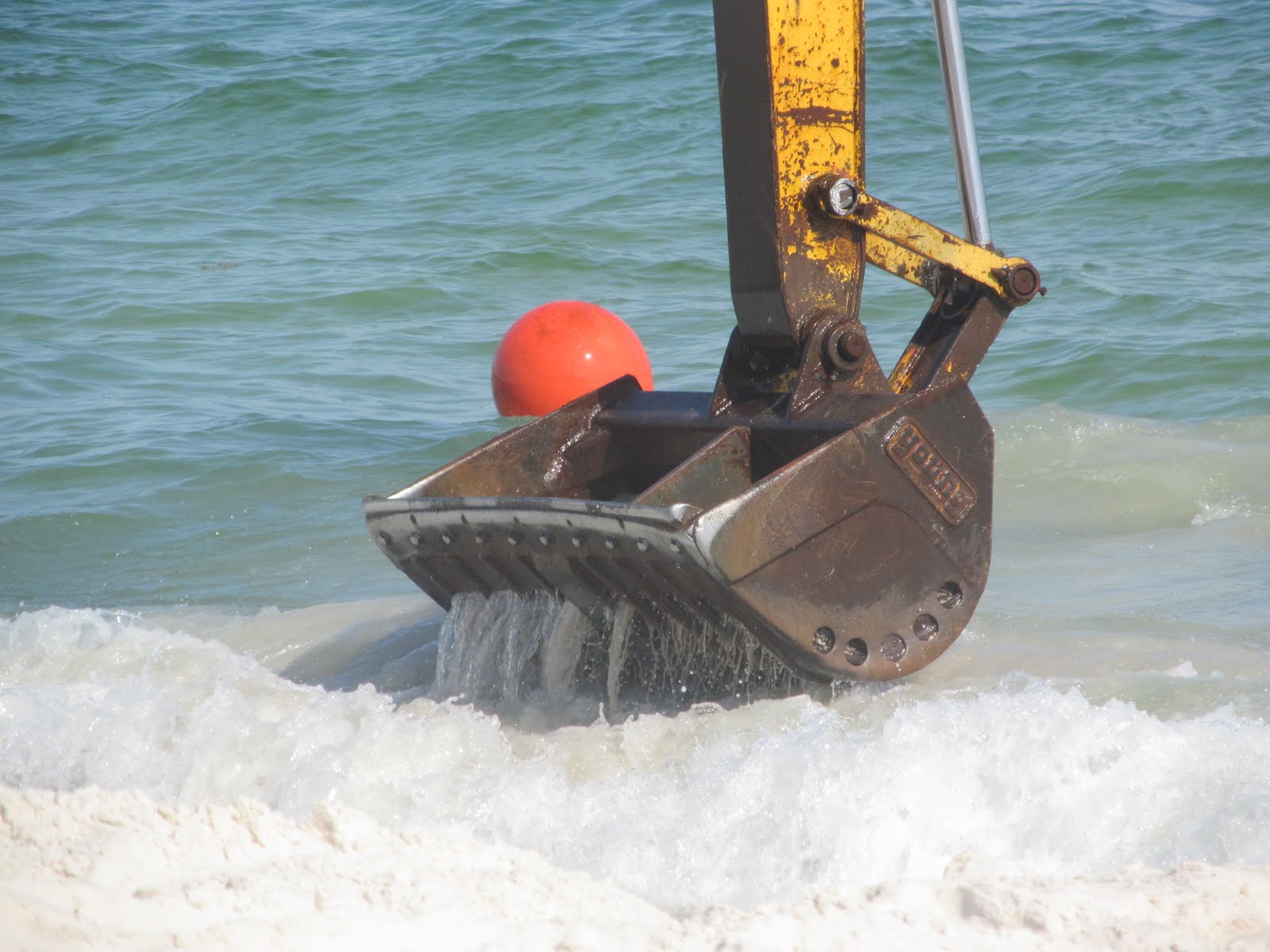
Sifting taking place

Sad version of BP Beach Blanket Bingo!

The Day's Haul

I am obviously happy they are going after the subsea oil, but I realize that this is basically just a media event.
Wednesday, May 11, 2011
BP working to remove tar mats on Perdido Key | Pensacola News Journal | pnj.com
Originally Published by the Pensacola News Journal
BP working to remove tar mats on Perdido Key | Pensacola News Journal | pnj.com: "BP working to remove tar mats on Perdido Key"
BP contractors have begun work today to remove two more submerged oil mats just off the beach near Eden Condominium on Perdido Key.
The process is expected to take four days for each tar mat, weather permitting, said Floyd Sanders, section planning chief for BP’s Florida restoration organization.
These oil mats were discovered in late April by a shoreline assessment team of representatives from BP, Florida Department of Environmental Protection and the Coast Guard. One mat is just east and the other just west of the oil mat that was removed in March. Sanders said.
The mats are in about 3 feet of water and are being removed by an excavator sitting on the beach. The excavator is able to dig up the underwater mats that are buried in the sand on the Gulf floor. The excavator’s arm can reach up to 45 feet offshore.
Once the job is completed, the areas will be reassessed to make sure all of the mats were removed, Sanders said.
The operations are independent of, but coincide with, a plan BP is about to launch to test a number of sonar methods to search for suspected tar mats farther offshore – between water that is four feet deep out to the edge of the second sand bar -- along Pensacola and Perdido key beaches. That operation is expected to take more than two months.
BP working to remove tar mats on Perdido Key | Pensacola News Journal | pnj.com: "BP working to remove tar mats on Perdido Key"
BP contractors have begun work today to remove two more submerged oil mats just off the beach near Eden Condominium on Perdido Key.
The process is expected to take four days for each tar mat, weather permitting, said Floyd Sanders, section planning chief for BP’s Florida restoration organization.
These oil mats were discovered in late April by a shoreline assessment team of representatives from BP, Florida Department of Environmental Protection and the Coast Guard. One mat is just east and the other just west of the oil mat that was removed in March. Sanders said.
The mats are in about 3 feet of water and are being removed by an excavator sitting on the beach. The excavator is able to dig up the underwater mats that are buried in the sand on the Gulf floor. The excavator’s arm can reach up to 45 feet offshore.
Once the job is completed, the areas will be reassessed to make sure all of the mats were removed, Sanders said.
The operations are independent of, but coincide with, a plan BP is about to launch to test a number of sonar methods to search for suspected tar mats farther offshore – between water that is four feet deep out to the edge of the second sand bar -- along Pensacola and Perdido key beaches. That operation is expected to take more than two months.
Editorial: Gulf research is critical
Editorial: Gulf research is critical
Originally Published by Pensacola News Journal
Link: http://www.pnj.com/article/20110511/OPINION/105110309/Editorial-Gulf-research-critical?odyssey=mod|newswell|text|FRONTPAGE|p
Concerns about sick red snapper and other fish in the Gulf of Mexico make clear the importance of continued, long-range research into the environmental impact of the BP oil spill.
The layman's logical step is to conclude that the problems in the fish — including skin lesions, spots, liver blood clots and fin rot — are connected to the oil spill. But scientists admit they don't yet know the cause, and that it could be something else.
Maybe it's a natural condition that has been exacerbated by the stress the spill induced in fish.
A roster of state and federal agencies testing seafood assure us that it is safe. They report no traces of oil-related chemicals being found in commercially available seafood. But perhaps their testing method — obtaining fish from local seafood markets across the Gulf Coast — selects out the sick fish because fishermen don't try to sell them to the markets, or else the markets won't buy them.
That could simultaneously mean that seafood available for sale is indeed safe, but that there are also sick fish out there.
It could also raise concerns about how long the fish are sick before these problems manifest themselves. Could the sickness in the fish make them unhealthy for human consumption even though they don't show any signs of oil contamination at that point?
It shows the complexity involved in trying to identify environmental problems.
Dick Snyder, director of the University of West Florida's Center for Environmental Diagnostics and Bioremediation, made the point well: "Cause and effect is a huge problem for environmental work. You see anomalies in fish. Is it oil related? How do we prove it? We can make the connection with economic stuff. But after the oil is gone, how do you definitely say the fish are sick because of the oil spill?"
Snyder said that we might never know the full impact. But the only real chance we have is to continue the research, and to increase the focus anytime a specific problem surfaces.
Certainly, this problem is one that bears more intense scrutiny
Originally Published by Pensacola News Journal
Link: http://www.pnj.com/article/20110511/OPINION/105110309/Editorial-Gulf-research-critical?odyssey=mod|newswell|text|FRONTPAGE|p
Concerns about sick red snapper and other fish in the Gulf of Mexico make clear the importance of continued, long-range research into the environmental impact of the BP oil spill.
The layman's logical step is to conclude that the problems in the fish — including skin lesions, spots, liver blood clots and fin rot — are connected to the oil spill. But scientists admit they don't yet know the cause, and that it could be something else.
Maybe it's a natural condition that has been exacerbated by the stress the spill induced in fish.
A roster of state and federal agencies testing seafood assure us that it is safe. They report no traces of oil-related chemicals being found in commercially available seafood. But perhaps their testing method — obtaining fish from local seafood markets across the Gulf Coast — selects out the sick fish because fishermen don't try to sell them to the markets, or else the markets won't buy them.
That could simultaneously mean that seafood available for sale is indeed safe, but that there are also sick fish out there.
It could also raise concerns about how long the fish are sick before these problems manifest themselves. Could the sickness in the fish make them unhealthy for human consumption even though they don't show any signs of oil contamination at that point?
It shows the complexity involved in trying to identify environmental problems.
Dick Snyder, director of the University of West Florida's Center for Environmental Diagnostics and Bioremediation, made the point well: "Cause and effect is a huge problem for environmental work. You see anomalies in fish. Is it oil related? How do we prove it? We can make the connection with economic stuff. But after the oil is gone, how do you definitely say the fish are sick because of the oil spill?"
Snyder said that we might never know the full impact. But the only real chance we have is to continue the research, and to increase the focus anytime a specific problem surfaces.
Certainly, this problem is one that bears more intense scrutiny
Subscribe to:
Posts (Atom)